May 9, 2026
Apartment Finding Service: What’s Included and What’s Not
Apartment finding service guide: learn what is included, what costs extra, and how expats can choose safer tenant-side support.
Struggling to find the perfect home? Explore Movely services that can help you!

Apartment properties can look perfect in listing photos and still be a poor fit once you live there. The unit may be bright, renovated, and priced well, but the building can add hidden costs, unreliable maintenance, noise, security issues, restrictive rules, or avoidable application risk.
That matters even more if you are relocating from another country. Applying often means sharing sensitive documents, paying nonrefundable fees, moving quickly, and trusting people you have not met in person. Before you submit an application, vet the building as carefully as you vet the apartment itself.
This guide focuses on the property-level checks that happen before you apply: who manages the building, what current tenants say, what the common areas reveal, which fees are easy to miss, and what to verify if you are renting remotely.
A rental decision has two layers. The first is the apartment: layout, light, appliances, storage, and condition. The second is the property: ownership, management, building systems, rules, neighbors, amenities, safety, and total cost.
Many renters over-focus on the first layer because it is visible in photos. But long-term livability is often decided by the second. A beautiful apartment in a poorly maintained building can mean slow repairs, elevator outages, pest issues, heating problems, package theft, surprise fees, or strict rules that do not match your life.
Vetting apartment properties before you apply helps you answer five practical questions:
If the answer to any of these is unclear, pause before sending money or documents.
The first check is basic legitimacy. Scammers and low-quality operators often rely on speed, vague details, and renters who are afraid of missing out. Slow the process down just enough to confirm that the building, unit, owner, agent, and payment instructions all connect.
Compare the listing address across multiple sources. Search the exact address, building name, property manager, and agent name. Look for consistency across listing portals, the management company website, map results, and any public registry or licensing database available in that city.
Ask for the legal name of the landlord, property manager, or agency. If an agent is involved, ask which company they represent and whether they are authorized to market that unit. In some countries or states, agents must be licensed. In others, landlord-side agencies are common but less regulated. Either way, a legitimate representative should be able to explain their role clearly.
A professional-looking website is helpful, but it is not proof by itself. Many legitimate businesses invest in strong websites, SEO, and branding through specialists such as Digidatale, a digital agency in La Réunion, while scammers can also copy logos, photos, and company names. Treat online presence as a starting signal, then verify identity through records, direct company contact, and traceable communication.
For remote renters, the safest sequence is simple: verify first, share sensitive documents second, pay only after the lease terms and payee are confirmed. The FTC’s guidance on rental listing scams is especially relevant if anyone pressures you to wire money, pay through unusual methods, or skip a real-time viewing.
Reviews can be useful, but only if you read them for patterns rather than drama. One angry review may reflect a one-off dispute. Ten reviews over several months mentioning the same issue deserve attention.
Search the building name, address, landlord name, and management company name. If you are moving abroad, search in the local language too. A building marketed to international renters may have English-language listings, but the most revealing tenant discussions may be on local forums, neighborhood groups, map reviews, or country-specific rental platforms.
Pay close attention to repeated mentions of maintenance delays, pests, elevator problems, heating or cooling outages, water leaks, mold, noise, deposit disputes, security concerns, package theft, and unresponsive management. These issues affect the building experience even if the individual unit looks fine.
Also look at how management responds. Defensive replies, copy-paste answers, or public arguments with tenants are not encouraging. Better signs include specific responses, acknowledgment of issues, and evidence that management explains what has been fixed.
Do not expect perfection. Large apartment properties almost always have some negative reviews. Your goal is to identify whether the complaints are isolated, old, or recurring and current.
Where available, public records can reveal issues that listings will not mention. The exact sources vary by country and city, but many local governments publish some combination of building permits, housing code violations, fire safety records, planning applications, short-term rental licenses, energy ratings, tax records, or ownership information.
You do not need to become a legal investigator. You are looking for practical signals. Recent permits may explain construction noise. Open violations may indicate unresolved maintenance or safety concerns. Repeated complaints about heat, elevators, trash, or pests may suggest a building-level problem rather than a single tenant’s bad luck.
If public records are hard to interpret, ask direct questions. For example: Has there been major construction recently? Are there planned works during the lease term? Have the elevators, heating system, roof, or plumbing had recurring outages? Are there active building assessments or owner association disputes that could affect tenants?
During an in-person or video viewing, ask to see the common areas, not only the apartment. The lobby, hallways, stairwells, elevator, laundry room, trash area, garage, bike room, mailroom, and exterior entrance often reveal more about management quality than a staged unit.
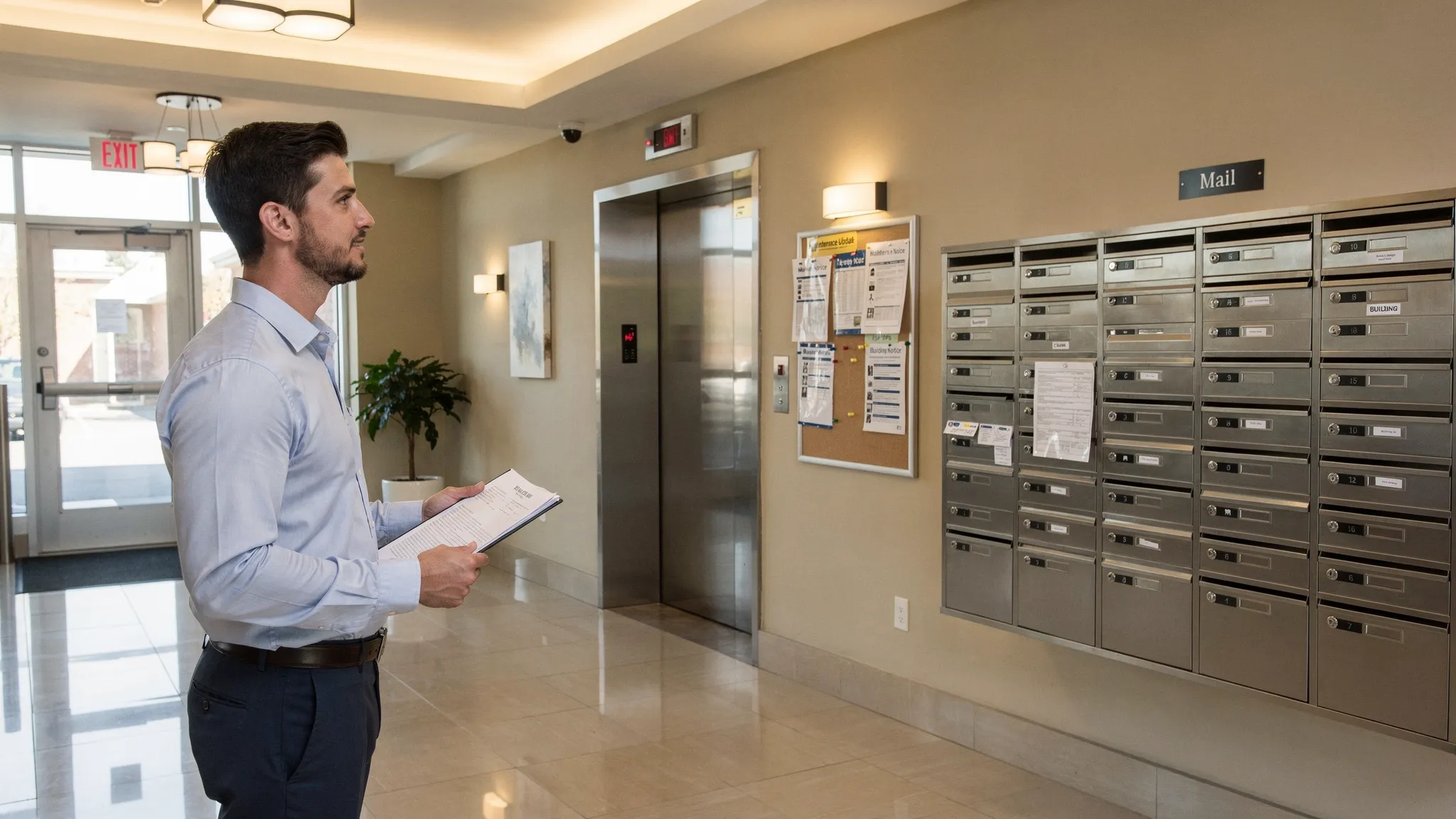
Look for signs of neglect: persistent odors, overflowing trash, broken entry doors, damaged lighting, old leak stains, unsecured mail areas, pest traps in plain sight, or maintenance notices that are months out of date. One issue may be manageable. Several issues together suggest a building that is not being operated carefully.
For a unit-specific inspection checklist, use Movely’s apartment viewing checklist alongside these building-level checks.
Advertised rent is not always the price you will actually pay. Apartment properties can carry building-specific charges that change the real monthly cost, especially in professionally managed buildings, condo buildings, furnished rentals, and expat-heavy markets.
Before applying, ask for a written fee sheet or full cost breakdown. If the manager cannot provide one, that is a warning sign. You should understand both move-in costs and recurring costs.
Common costs to verify include:
The names of these costs vary by country. In some markets, heating and water may be included. In others, the tenant must open accounts, transfer utilities, or pay building common expenses separately. If you are comparing two apartments, compare total monthly cost rather than rent alone.
Movely’s utilities setup checklist can help you identify services that may not be included, while the guide to security deposit rules explains why deposit expectations can differ by location.
A building is only as good as the people who operate it. Before you apply, pay attention to how management communicates. The application stage is often the best service you will ever receive. If communication is already slow, vague, or disorganized, it may not improve after you sign.
Good management usually provides clear answers, written policies, consistent names and email addresses, realistic timelines, and a normal payment process. They can explain how maintenance requests are submitted, who handles emergencies, how repairs are prioritized, and what tenants should do outside business hours.
Ask who is responsible for the unit and who is responsible for the building. This matters in condo buildings and private landlord situations. Your landlord may control the apartment, but the building association may control elevators, lobby access, common repairs, trash rules, and move-in logistics.
If the landlord says building issues are not their responsibility, ask how tenant problems are escalated. You do not want to discover after move-in that no one can resolve a broken elevator, leaking roof, or unreliable heating system.
For more warning signs in landlord behavior, see Movely’s guide on how to spot a bad landlord before you sign a lease.
Safety is not only about crime statistics. It is also about whether the property is designed and managed in a way that supports normal daily life.
Check the entrance. Is the exterior door secure? Does the intercom work? Are hallways and stairwells well lit? Are mailboxes or package areas protected? Are emergency exits visible and usable? Are smoke alarms, carbon monoxide detectors, or fire safety features present where required by local law?
Then think about your routine. If you work late, can you enter safely at night? If you receive deliveries, where do packages go? If you bike, is there secure storage? If you drive, is parking included, assigned, or competitive? If you have mobility needs, are there stairs, elevator limitations, heavy doors, or uneven paths?
The area immediately around the property matters too. A building can be in the right neighborhood but on the wrong block. Check noise sources such as bars, highways, train lines, schools, construction sites, loading docks, and late-night businesses. Visit at different times if possible. If you are remote, ask for a live video that starts outside the building and shows the surrounding street.
For a deeper location strategy, Movely’s guide on choosing a neighborhood when you’re new in town explains how to evaluate daily life, commute reliability, and micro-area fit.
Apartment properties often have house rules that matter as much as the lease. These rules may come from the landlord, property manager, building association, condo board, or local regulation. Ask for them before you apply, especially if any part of your lifestyle is nonstandard.
Confirm rules for pets, guests, smoking, balconies, grills, bikes, storage, parking, quiet hours, musical instruments, home offices, renovations, wall mounting, short-term guests, and subletting. If you are relocating with children, pets, roommates, or frequent visitors, do not rely on assumptions.
Move-in rules can also create surprises. Some buildings require elevator reservations, weekday move-in windows, proof of insurance from movers, parking permits for moving trucks, or refundable building deposits. These details can affect your arrival schedule and moving budget.
For expats, one more point matters: whether the address can be used for required local registration, visa administration, bank setup, school enrollment, or residency paperwork. In some countries, temporary contracts, sublets, or informal arrangements may not support the administrative steps you need after arrival.
If the property representative cannot confirm rules in writing, pause. Verbal promises are easy to forget and hard to enforce.
Remote renters need a stronger process because they cannot easily notice smells, noise, access problems, or neighborhood conditions. A live video viewing is the minimum, not a bonus.
Ask the representative to show the exterior, entrance, lobby, elevator or stairs, hallways, trash area, laundry or parking if relevant, and the route from the building entrance to the apartment. During the call, make simple real-time requests, such as asking them to open a window, show the street name, test the intercom, run water, or step into the hallway. Real-time interaction is harder to fake than a prerecorded video.
Use independent sources too. Check map imagery, transit routes, local forums, official records where available, and recent reviews. If you do not speak the local language, translate key searches for the address and management company. Many of the most useful warnings are not written in English.
Be careful with documents. It is normal for landlords to request proof of identity, income, and rental history, but you should not send a full passport scan, bank statements, or employer details to an unverified person. Redact unnecessary account numbers, use secure sharing, and keep a record of exactly what you sent.
Movely’s remote apartment hunting guide covers sight-unseen safeguards in more detail, and the rental marketplace safety checklist can help you avoid fake listings and unsafe payment sequences.
You do not need days of research for every listing. Use a fast, repeatable workflow and reserve deeper checks for your finalists.
This system prevents you from over-researching weak listings while still protecting you from costly mistakes.
Some warning signs do not automatically mean a property is unsafe, but they should make you pause and ask for proof. Others are strong enough to walk away.
Be cautious if the representative refuses a live viewing, avoids showing common areas, gives inconsistent names, uses a personal email for a supposed large company, pressures you to pay before signing, asks for untraceable payment methods, or claims they cannot provide a lease template or written fee breakdown.
Property-level red flags include unsecured exterior doors, repeated pest complaints, chronic elevator outages, visible water damage, neglected trash areas, unclear utility responsibilities, surprise building fees, aggressive review responses, and rules that conflict with your relocation needs.
The biggest warning sign is pressure. Competitive markets move quickly, but legitimate landlords and managers still understand basic verification. If you are told that you must pay immediately, skip review, or ignore inconsistencies, it is safer to lose the listing than to lose your money or personal data.
A few direct questions can reveal whether the building is worth pursuing. Send them before applying, or ask during the viewing and confirm the answers in writing afterward.
If the answers are clear and consistent, you can apply with more confidence. If the answers are vague, contradictory, or only verbal, keep looking or get help reviewing the situation.
How do I check if an apartment property is legitimate? Match the listing address, landlord or manager name, agent identity, company website, and payment instructions across multiple sources. Use official registries or licensing databases where available, ask for written proof of authority, and avoid paying before you have verified the lease, payee, and property.
Should I apply before viewing the building? In very competitive markets, some renters apply quickly, but it is risky to apply before verifying the property. At minimum, request a live video tour that includes common areas and the exterior, confirm all fees in writing, and verify who is collecting your documents and money.
Are online reviews reliable for apartment properties? Reviews are useful when you look for repeated, recent patterns rather than isolated complaints. Recurring mentions of pests, elevator outages, deposit disputes, noise, or slow repairs are more important than one extreme review.
What building issues matter most before applying? Prioritize issues that affect health, safety, cost, and daily reliability: secure access, water leaks, mold, pests, heating or cooling, elevators, trash, noise, unclear fees, and unresponsive management.
How can expats vet a building from abroad? Use a live video viewing, local-language searches, map checks, public records where available, and verified payment sequencing. If the market is unfamiliar or language is a barrier, a tenant-side local representative can inspect the building, ask questions, and reduce risk before you apply.
A good apartment search is not only about finding listings. It is about verifying the building, understanding the rules, protecting your documents, and applying only when the risk makes sense.
Movely helps expats and relocating renters find and secure long-term housing abroad with AI-assisted and manual search, local agents, supervised viewings, multilingual support, tenant portfolio improvement, contract legal review, and post move-in assistance. If you are trying to evaluate apartment properties from another country, Movely can help you move faster without skipping the checks that matter.
Start with a safer, tenant-side search at wemovely.com.