Back to Blog

How to Avoid Rental Scams When Moving to a New Country

Rental scams are stressful anywhere. When you are moving to a new country, they become more dangerous because scammers can exploit distance, language barriers, unfamiliar laws, and the pressure to secure housing fast.

The good news is that most rental fraud follows predictable patterns. If you use a consistent verification process, you can filter out the majority of scams before you ever send money or share sensitive documents.

Why rental scams target people moving abroad

International movers are ideal targets because:

  • You may not be able to tour the property in person.
  • You might not know normal pricing, standard lease terms, or what deposits look like locally.
  • You are often working with a tight timeline (start date, visa appointment, school enrollment).
  • Cross-border payments and jurisdiction make recovery harder.

The FBI has repeatedly warned that rental and real estate fraud often relies on urgency, impersonation, and pressure to pay before verification is possible. A practical takeaway is simple: anyone who tries to prevent verification is signaling risk. You can review reporting trends and prevention advice via the FBI Internet Crime Complaint Center (IC3).

The most common rental scams (and what they look like in real life)

Scammers mix and match tactics, but the underlying goal is usually one of two things: get your money, or get your identity documents.

Fake listings with stolen photos

A scammer copies photos from a real listing, a hotel, or a past rental ad, then reposts it with a new email or WhatsApp number. They may claim they are “out of the country” and can only do a remote handover.

How to spot it:

  • The same photos appear on multiple sites with different addresses or prices.
  • The description is generic, overly polished, or oddly translated.
  • The contact insists on taking the conversation off-platform immediately.

“I’m overseas, pay first, keys later”

This is one of the oldest patterns: the “landlord” claims they are abroad for work, mission trips, or family emergencies. They offer to mail keys after you pay a deposit.

In legitimate rentals, it is normal to pay a deposit close to move-in, but it is not normal to pay a stranger before confirming they control the property.

Underpriced “too good to be true” rentals

If a place is 30 to 50 percent below market for the neighborhood, scammers will explain it away with a story about needing a “fast, respectful tenant.”

A better explanation is often that the property does not exist or is not theirs.

“Holding deposit” and viewing fee scams

Some scammers ask for a small amount to “reserve” a viewing slot, to “take it off the market,” or to process your application. After you pay, they disappear, or they keep pushing for additional fees.

Rules vary by country, but fees before you have verified the property and the landlord are a high-risk zone.

Payment method traps (wire, crypto, gift cards)

Scammers prefer irreversible payments:

  • International wire transfers
  • Crypto
  • Money transfer services
  • Gift cards

Consumer protection agencies repeatedly warn that these methods are common in fraud because they are difficult or impossible to reverse. In the US, the FTC’s scam guidance is a solid starting point for understanding payment red flags.

Identity theft via “application screening”

A scammer may appear to run a normal application process and ask for passport scans, national IDs, bank statements, payslips, or even a full set of documents “for the landlord’s file.”

If they are not the real landlord or agent, you have just handed over everything needed for identity fraud.

A practical anti-scam process you can reuse for any country

The goal is not to become a real estate investigator. It is to follow a repeatable checklist that forces legitimacy to reveal itself.

Validate the listing before you talk money

Start with the listing itself:

  • Reverse image search the photos (Google Images or TinEye). If the images appear elsewhere, you need an explanation you can verify.
  • Check the address on a map and street view where available. Does the building type match the photos? Does the neighborhood match the description?
  • Compare price to the local market using multiple sources (major portals, local agencies, expat housing groups, university housing pages). One cheap listing can happen, but if it is dramatically cheaper, treat it as suspicious until proven otherwise.
  • Look for listing history clues: newly created accounts, copied text, and a refusal to provide additional photos or a live tour are all risk signals.

If the listing cannot survive basic internet cross-checks, do not “keep talking just in case.” That is how urgency wins.

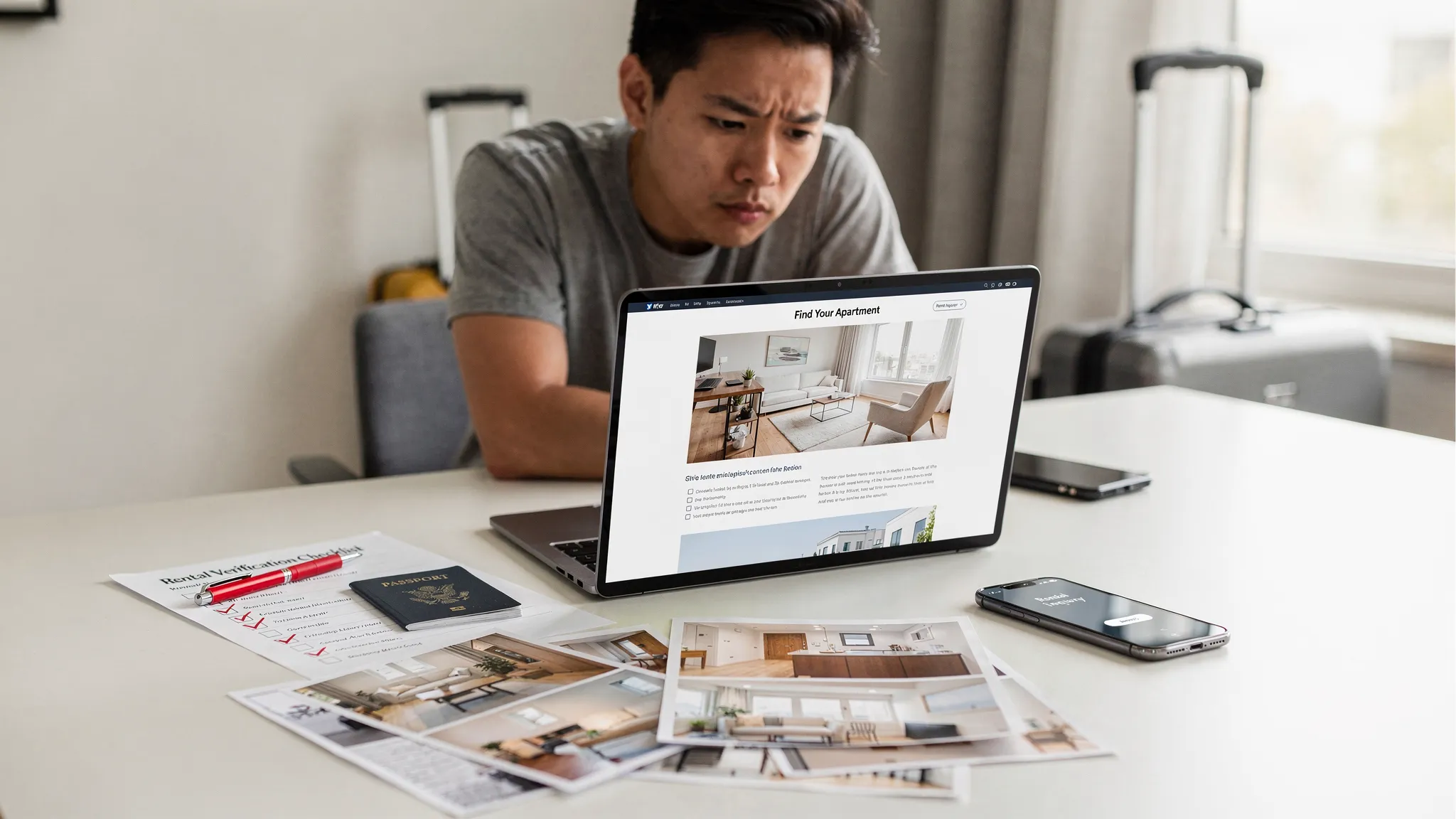
A person preparing to rent abroad sits at a desk with a passport, a laptop (screen facing the viewer but blank), printed listing photos, and a checklist with red flags highlighted, conveying careful verification before sending money.

Verify the person’s authority to rent the home

Your job is to confirm one thing: does this person have the legal right to rent this property?

Ways to do that, depending on the country:

  • Ask for the full legal name and the exact property address, then check whether there is a property registry or land records lookup in that country or region.
  • If they claim to be an agent, ask for their license number or agency registration and verify it on the regulator’s site (many countries have public lookups).
  • Ask for a live video call where they walk through the home and show something time-specific (for example, today’s date on a piece of paper, or a live view out the window that matches the street).
  • Ask questions that a real owner or property manager can answer quickly (utility setup process, building entry rules, trash days, required move-in inventory forms, typical internet providers).

Be careful with document “proof.” IDs can be stolen, and PDF ownership documents can be forged. That is why live verification and independent checks matter.

Confirm the property is actually available

Even if the place is real, scammers can be running a “rental hijack” where they advertise a real home they do not control.

To reduce this risk:

  • Request a live tour (not a pre-recorded video). Pre-recorded videos are easy to steal.
  • If you have a trusted contact locally, ask them to visit the property or at least confirm the building and unit exist.
  • If the property is in a managed building, call the building management or front desk (if applicable) and ask whether the unit is owner-managed, agent-managed, or not for rent.

Use payment methods that preserve your leverage

A good rule: if the payment method is chosen because it is irreversible, it benefits the sender of the request, not you.

Prefer options that create a paper trail and possible dispute mechanisms:

  • Paying through a reputable rental platform that processes payments and holds records
  • Credit card payments (where possible) with dispute rights
  • Bank transfers only after you have verified the landlord or agency and signed a legitimate lease (and only to an account that matches the verified legal entity)

Avoid:

  • Crypto
  • Gift cards
  • “Money transfer to a friend” style transactions
  • Payments to an account name that does not match the landlord or licensed agency

If you are unsure what is normal locally (some countries rely heavily on bank transfers), the key is sequencing: verification first, payment second.

Treat the lease as a verification tool, not paperwork

A legitimate lease should reduce uncertainty, not add it.

Before signing:

  • Ensure the names match across the lease, payment details, and the verified owner or agency.
  • Confirm the address format is precise (unit number, building name, floor). Vague addresses are a common fraud pattern.
  • Confirm what the deposit is for, where it is held, and what the move-out conditions are.
  • Ask who pays which utilities, what “furnished” includes, and what happens if repairs are needed.

If the lease is not in your strongest language, pay for a translation or a local legal review. It can cost money, but it is often cheaper than one wrong deposit.

Limit what personal data you share early

When you are applying from abroad, some documentation is normal. The mistake is sharing everything too early.

A safer progression:

  • Early stage: basic information (name, intended move-in date, employment or student status) and questions about terms.
  • After verification and a legitimate viewing: limited documentation necessary to assess eligibility.
  • Only when you are confident: more sensitive documents, and ideally via a secure upload process rather than email.

If someone asks for passport scans on day one, treat that as a red flag unless you can independently confirm they are a licensed agent or the verified property manager.

Safer ways to secure housing when you cannot visit yet

If you are moving internationally, your best anti-scam move is often strategic, not detective work.

Use a short-term landing plan

Consider booking a short-term stay for your first 2 to 6 weeks (serviced apartment, extended-stay hotel, reputable short-term rental) and then renting long-term once you are on the ground.

This approach:

  • Lets you tour multiple properties quickly
  • Reduces pressure to send money from abroad
  • Helps you learn which neighborhoods and commute patterns actually work

Prefer professionally managed properties when possible

Large property managers and established agencies can still be imperfect, but scams are less common than in one-off “private landlord via messaging app” situations.

If you work with an agent, verify licensing and company presence. Look for:

  • A real office address
  • A company domain email (not just free webmail)
  • Reviews that are specific and consistent (but be cautious, reviews can be faked)

Ask your employer or school what “normal” looks like

Many employers, universities, and relocation departments maintain country-specific guidance on:

  • Typical deposits
  • Common lease lengths
  • Required registration steps
  • Known scam patterns affecting newcomers

Even a brief email can help you avoid the biggest cultural and legal surprises.

Red flags that should stop the process immediately

Not every red flag proves fraud, but multiple red flags should end the conversation.

  • Refusal to do a live video tour or in-person viewing via a representative
  • Pressure tactics like “many other applicants, pay in the next hour”
  • Requests for crypto, gift cards, or money transfer apps designed for friends and family
  • Price far below market with an emotional story as the justification
  • The owner or agent will not provide a verifiable legal name and local contact information
  • Payment account name does not match the landlord or agency name on the lease
  • You are asked for excessive personal documents before you have verified legitimacy
  • The listing disappears and reappears under different names or addresses

What to do if you think you are being scammed

Speed matters. The earlier you act, the better your chances of limiting damage.

First steps:

  • Stop communication and do not send additional money or documents.
  • Screenshot everything: listing URL, messages, payment instructions, IDs provided, phone numbers, email headers.
  • Notify the platform where you found the listing.
  • Contact your bank or card issuer immediately to ask about recall, chargeback, or fraud processes.

Reporting options (choose what fits your location):

  • United States: report to the FTC and the FBI IC3.
  • United Kingdom: report via Action Fraud.
  • European Union: your country’s consumer protection authority, and you can also reference resources from Europol for cross-border crime context.

If you shared identity documents, consider placing fraud alerts or credit freezes where available in your home country, and ask your bank what additional monitoring they recommend.

A simple mindset that prevents most losses

When moving to a new country, it is easy to treat housing as a race. Scammers thrive on that feeling.

A safer approach is to treat every rental as a two-part decision:

  • Is the apartment right for me?
  • Is the counterparty verifiably legitimate?

You can fall in love with a space and still walk away if the verification steps do not check out. In international moves, walking away is often the smartest financial decision you make.


- **`xs`** → `--space-xs` = `0.5rem` (≈ 8px)  
- **`sm`** → `--space-sm` = `0.625rem` (≈ 10px)  
- **`s`** → `--space-s` = `0.75rem` (≈ 12px)  
- **`m`** → `--space-m` = `1rem` (≈ 16px, базовый)  
- **`md`** → `--space-md` = `1.25rem` (≈ 20px)  
- **`l`** → `--space-l` = `1.5rem` (≈ 24px)  
- **`xl`** → `--space-xl` = `2rem` (≈ 32px)  
- **`2xl`** → `--space-2xl` = `3rem` (≈ 48px)  
- **`3xl`** → `--space-3xl` = `4rem` (≈ 64px)  
- **`4xl`** → `--space-4xl` = `5rem` (≈ 80px)  
- **`huge`** → `--space-huge` = `3.75rem` (≈ 60px, спец‑размер)  
- **`giant`** → `--space-giant` = `6.25rem` (≈ 100px, максимум)

#### 3.1. Margin (десктоп)

- `mt-*` — `margin-top`  
- `mb-*` — `margin-bottom`  
- `mv-*` — вертикальный margin (top + bottom)

#### 3.2. Margin (мобильный)

Те же, но с префиксом `m-`:

- `m-mt-*`, `m-mb-*`, `m-mv-*`

#### 3.3. Padding (десктоп)

- `p-*` — padding со всех сторон  
- `pv-*` — padding по вертикали (top + bottom)  
- `ph-*` — padding по горизонтали (left + right)  
- `pt-*` — `padding-top`  
- `pb-*` — `padding-bottom`  
- `pl-*` — `padding-left`  
- `pr-*` — `padding-right`

Аналогично, но с `m-`:

- `m-p-*`, `m-pv-*`, `m-ph-*`, `m-pt-*`, `m-pb-*`, `m-pl-*`, `m-pr-*`

#### 3.5. Gap

- `gap-*` — `gap` между элементами (flex/grid), базовое значение.  
- `m-gap-*` — `gap` только на мобилках.

- `fl-l` — `display: flex; justify-content: flex-start;`  
- `fl-c` — `display: flex; justify-content: center;`  
- `fl-r` — `display: flex; justify-content: flex-end;`  
- `fl-m` — центр и по горизонтали, и по вертикали (`justify-content: center; align-items: center;`)  
- `fl-btwn` — `justify-content: space-between;`  
- `fl-w` — `flex-wrap: wrap;`  

- `ta-l` — `text-align: left;`  
- `ta-c` — `text-align: center;`  
- `ta-r` — `text-align: right;`

- `m-ta-l`, `m-ta-c`, `m-ta-r`